YEZAutomotive
Car repair marketplace that stayed fast when suppliers were slow
An online marketplace for car repair. Car owners pick the job, see the price for parts and labour, and book a repair shop. As CTO, I hired the team and built the platform from zero.
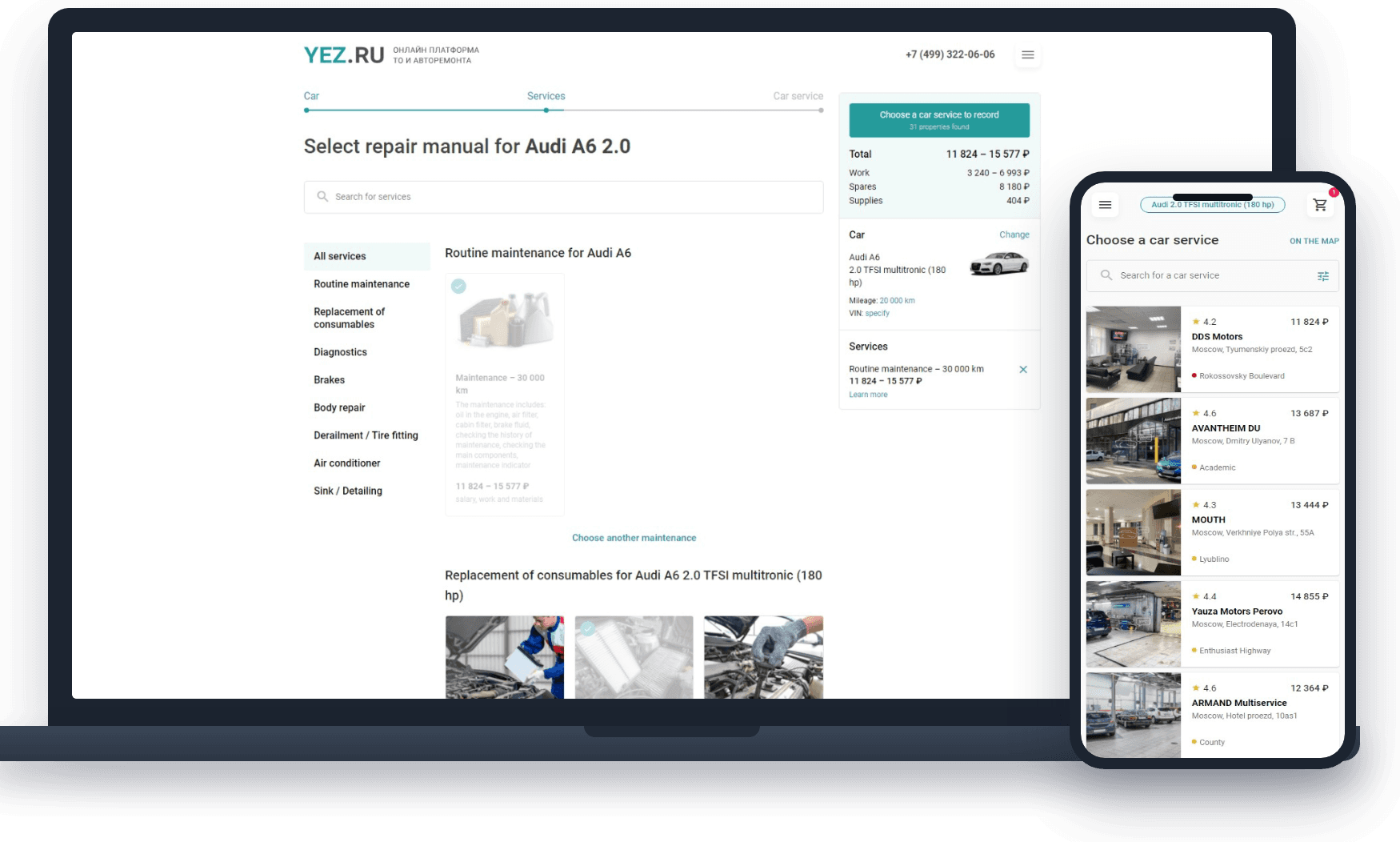
Part prices came from outside suppliers. Their systems were slow, limited how often we could call them, and were sometimes down. A customer still had to see a price while they waited, as easily as booking a hotel. And no single source said which part fits which car, so we had to build that data ourselves.
I started with no team and no product.
A product that depends on other companies' systems can pass every demo and still fail with real users. In a Review, I check what happens to your product when those systems are slow or down.
- 5
Parts suppliers
APIs, a CSV price list, an emailed Excel file
- 2
Payment providers
Card payments for repair orders
- 2
Receipt services
A receipt for every payment, required by law
- 3+
CRM, SMS, maps
Customer records, text messages, addresses
10+ external APIs. Any of them could be slow or down.
The same questions I ask about your product
Every outside system failed at some point. Customers did not notice. Here is how, and under each one: what I look for in your product.
When a supplier is slow or down
Supplier prices were copied into our own database in the background. A quote never called a supplier, so a slow or broken supplier could not stop a sale.
In your product I check
What your product does when an API it depends on is slow, down or out of credit.
- Supplier API
- Supplier API
- Supplier API
- CSV price list
- Emailed Excel
5 parts suppliers, each with its own format and limits
Background sync
Uses only 70% of each supplier's daily limit. Oldest prices are refreshed first.
Our own price database
PostgreSQL, with a Redis cache in front
Supplier down? Its prices get older. The quote page still works.
Staying inside API limits
Suppliers allowed 2,000 to 5,000 calls a day. A shared limiter spent only 70% of each daily limit, by design.
In your product I check
Whether one busy day can use up an API limit, or run up your AI bill.
Adding or switching a provider
Each supplier, payment and receipt service sat behind its own small interface. A new supplier meant one new adapter, not a change to the core.
In your product I check
How tied your product is to one vendor, and what it would cost to switch.
Data you can trust
Every price kept its update time. A quote left out prices older than the limit and logged why.
In your product I check
Whether old or wrong data can reach a customer without anyone noticing.
Brake pads, supplier B
Every price row keeps its update time
Checked before every quote
Older than the limit (7 days by default), out of stock or too slow to deliver? It stays out.
Fails: kept out, reason logged
Who can see which orders
One login for 6 apps and 10 roles. Each request was checked for the user's role and for who owns the record.
In your product I check
Whether a user can open someone else's order by changing a number in the address bar.
Errors someone hears about
Errors in the logs went out by email. A receipt that still failed after 24 hours of retries reached staff.
In your product I check
Whether a failed background job is retried, and whether anyone hears about it.
Payments and receipts
Every order followed 7 states, with each change logged. A lock stopped double payments. Pending payments were re-checked with the bank, and receipts were retried.
In your product I check
What happens when a payment callback is missed, or a customer clicks Pay twice.
Every order, 7 states
- 1Draft
- 2Sent to shop
- 3Sent to customer
- 4Confirmed
- 5Work started
- 6Work finished
- 7Closed
- or Canceled
Every change logged: who and when
A lock stops a double click paying twice
Payment
Bank callback missed? Every pending payment is re-checked with the bank every 30 minutes.
Receipt
Receipt service down? Retried for up to 24 hours, then staff get an email.
Nothing fails without someone hearing about it
Releases and backups
One release pipeline over 4 environments, with database changes as their own step. Daily database backups, and scripts to roll back and restore.
In your product I check
Whether there is a test copy of your product, and how a bad release is undone.
From no team to six apps in 1.5 years
6 months
to MVP, a pivot included
4 + 1
engineers I hired, plus a designer
483
database changes on the order database
4
environments on one release pipeline
A team from zero
I started with no team and no product. I hired 2 full-stack, 1 back-end and 1 QA engineer, plus a designer, and stayed hands-on in the code.
Plans from the business
Vision and requirements came from the business team. I turned them into tasks, sprints and a release plan, and talked to the suppliers' technical teams myself.
Standards and QA
I set the coding standards, the release process and a QA step. Six apps for four kinds of users ran on one shared core and one login.
One core, one login, clear limits between the parts. That is the structure I look for in a Review, because it lets a small team keep shipping.
What car owners, repair shops and the team got
For car owners
- Pick the car, down to the exact model and engine
- Choose a service and see the price for parts and labour
- Compare repair shops on a map, with ratings and prices
- Book a repair shop online, or order by phone
- Pay by card, with the receipt the law requires
For repair shops
- Their own app for orders, services and prices
- A text and an email when a customer books
- Extra work found during a repair goes to the customer as its own order
- Every order's history: what changed, who changed it, when
For the YEZ team
- A CRM for orders, customers and repair shops
- Spare-parts management: suppliers, prices and replacement parts
- Data tools: which part and which job fit which car, and the standard hours
- Car data loaded from 6 reference sources
- A public site with its own CMS, and promo codes
Technologies
Application
Data
Delivery
Integrations
What the client said
“Very stress-resistant, always even-tempered, responsive - perfect fit for a rapidly evolving and uncertain startup environment.”
“Michael was a Chief Software Developer at an e-commerce startup YEZ developing a multifaceted platform from scratch. As our product engineering lead he was architecting the entire tech platform staying at the same time 100% hands-on since the team at that time used to be very small. We worked closely on multiple tasks and Michael turned out to be not only a diligent full-stack software engineer with strong background and consistent track record, but a very nice guy to communicate with both during work and off the clock. Very stress-resistant, always even-tempered, responsive - perfect fit for a rapidly evolving and uncertain startup environment. Would highly recommend Michael for every team trying to tackle difficult and challenging task. He is a real pro.”

Is a deadlinecoming?
A round, an audit, a big customer, a vendor contract. Book a 30‑minute Risk Assessment Call. We go through who built your product, what must be ready before that date, and what breaks today.
Free. No preparation. You leave with your 3 biggest risks in writing, and an honest answer on whether a review is worth it now.